
Paul Magès Association
Search
Archive collectionPeriod 1908–2019

Paul Magès

The personal archives of the inventor of the Citroën hydropneumatic suspension — digitised, transcribed page by page, explained.

Try: hydropneumatic suspension · patent · DS

584

catalogued archives

1634

transcribed pages

7,14 %

from the digitised collection

1908–2019

period-covered

7.14% of the archives digitised and analysed — the work continues, box after box.

An inventor's journey

Forty-nine years at Citroën

From the workshops to the test roads, a story of drawings, intuition and teamwork.

1925 — 1940

Learning, organising, inventing

On 25 August 1925, Paul Magès joined Citroën as a draughtsman, at 17 and a half years old. He climbed the ranks quickly.

His project for reorganising the engine factory caught André Citroën's attention. After its implementation, he also studied the organisation of the bodywork and automotive electricity workshops.

1929
Head of scheduling at Gutenberg.
1934
Deputy head of the transport department.
1936
A self-control study group in February, then the reorganisation of the repair workshops in April.
1938
At the head of the Super-Control.
1940
Appointed quality engineer in September.
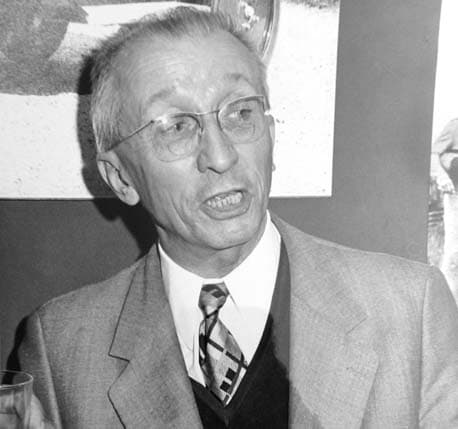
Portrait of Paul Magès
Paul Magès, in the family archives.

1942 — 1946

The idea of a new suspension

In 1942, Pierre Boulanger asked him to join the design office to think about the suspension of the future 2 CV. Paul Magès explored an idea: using a liquid to compress a gas.

In 1944, a first experimental system combined a gas reservoir with each wheel. It theoretically allowed the flexibility to be varied from one to four, but the cork separating the gas from the liquid could not withstand the high pressure.

He formed his own team, which manufactured the components, multiplied the tests and simplified the concept. In 1946, Boulanger asked him to continue on a Traction to prepare for the future VGD, the "Voiture Grande Diffusion".

Handwritten plan of a hydropneumatic suspension
A hydropneumatic suspension plan, dated 17 February 1944.

1949 — 1955

Testing the invention on the road

Tests continued in extreme cold in the Nordic countries, then in the intense heat of Algeria. On snow and difficult terrain, the idea of a manual height control was born.

With each campaign, the results led to new improvements. The hydropneumatic suspension was deemed sufficiently reliable in 1953 for a first application on the 15 Six, then on the DS 19.

A test car on a snowy road in Lapland
In Swedish Lapland, during the extreme cold tests of 1949.

1966 — 1974

Exploring beyond the suspension

In October 1966, he took responsibility for new studies. His research also touched on carburetion, road holding, steering, braking and semi-automatic gear changing.

Some inventions would never see the light of day, for lack of time or for economic and commercial reasons. The hydrostatic transmission remains one of his great unfinished projects: he had to interrupt its study upon retirement, even though it was already well advanced.

In September 1974, he left Citroën at the age of 66. His work helped write the legend of the brand.

Photograph of Paul Magès' retirement
Retirement, surrounded by his colleagues, in 1974.

Paul Ernest Mary Magès · Born in Aussois on 9 March 1908, died in Garches on 22 September 1999, at 91 years old.

Browse the timeline

The collections of the archive

A century of mechanics

Complete chronology

The scientific approach

01

Faithful transcription

Each page is transcribed verbatim, period spelling preserved. Doubtful passages are marked [uncertain], illegible passages [illegible].

02

Cataloguing

The digitised boxes are divided into individual archives — a letter, a plan, a report — dated with the precision actually attested: day, month, year or decade.

03

Analysis and context

Each archive is explained and contextualised, always distinguishing what the document says (cited page by page) from the general historical context.

Reader's visa

Join the Paul Magès Association

Contribute to the preservation and dissemination of this exceptional technical and historical heritage.